What if they just switch it off?
Something shifted this past week, and I don’t think enough people clocked it.
Anthropic pulled access to Fable 5, which is the guardrail version of their Mythos 5 model. Then they pulled Mythos 5 too. Both gone, for everyone, after a US government export control directive on the 12th of June. A few days later OpenAI previewed GPT-5.6, their new Sol model (along with Terra and Luna), and immediately limited it to a small group of trusted US partners, again at the government’s request. OpenAI even said the restrictions shouldn’t be the norm, which tells you they weren’t thrilled about it either.
So in the space of about two weeks, the two best labs in the world released their most capable models and then locked most of us out of them.
For context on how good these are: on TerminalBench 2.1, which throws real terminal engineering tasks at the models, GPT-5.6 Sol scored 88.8%, and 91.9% in its Ultra mode. That edges out Claude Mythos 5 at 88.0%. Opus 4.8, the one I can actually use, sits at 78.9%. So the gap between what’s gated and what’s public is real, and it’s widening.
Here’s what worries me. If access can be revoked at the government’s request, what happens if they decide to revoke it for everyone? Not foreign nationals, not a list of partners, everyone. You’d have a small group of people and companies with frontier intelligence, and everyone else stuck a tier or two below. That’s a permanent underclass, and I don’t want to be in it.
The way out is being able to run powerful models on your own hardware. This is why open source matters so much right now. A model like GLM 5.2 is open, MIT licensed, and roughly Opus 4.8 level. Nobody can switch that off. Once the weights are out, they’re out. If you’ve got the hardware to run it, you’re not asking anyone for permission.
Which brings up the question everyone actually has: which computer do you buy? Alex Finn did a good breakdown of this, and it basically comes down to three options.
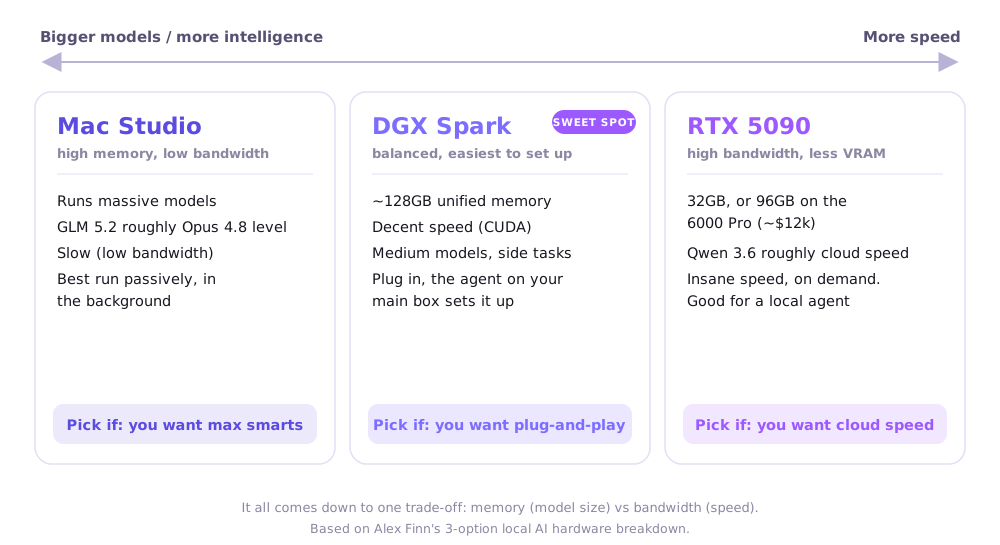
Mac Studio: huge memory, so it runs massive models, but low bandwidth means it’s slow. Good if you want frontier intelligence running passively in the background, like a security scan on your codebase that you read later, rather than something you’re waiting on live.
RTX 5090 (or the 6000 Pro): less VRAM but insane bandwidth, so the models run fast, as fast as cloud in some cases. This is the one if you want to run an agent off a local model and have it respond instantly.
DGX Spark: the sweet spot. 128GB of unified memory, decent speed off Nvidia’s CUDA, and it’s the easiest to get going. You plug it in and tell the agent on your main machine to go set it up, you don’t even need a monitor on it.
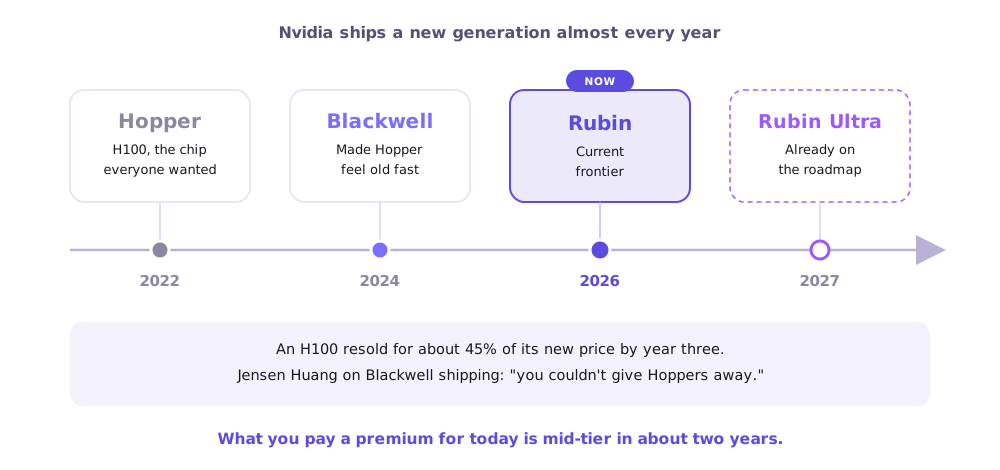
The catch, and it’s a real one, is that hardware goes out of date fast. Nvidia is on a yearly cadence now: Hopper in 2022, Blackwell in 2024, Rubin this year. An H100 was reselling for about 45% of its new price by year three. Jensen Huang himself said once Blackwell shipped, “you couldn’t give Hoppers away.” So whatever you buy is depreciating quickly, and the thing you pay a premium for today is mid-tier in two years.
So you’re caught between two things. Frontier models you might lose access to at any moment, and the hardware to run open ones yourself, which bleeds value the day you buy it. Neither is comfortable. But if I had to bet, I’d rather own the depreciating hardware and the open weights than be locked out entirely.
I’ll be honest, I haven’t gone and bought a Mac Studio or built a 5090 rig. What I did do, back in November, was buy a little Nvidia Jetson Orin Nano, the 8GB dev kit. It’s still in the box. I haven’t even opened it yet.
It’s worth being clear about what it is, because it’s not going to run GLM 5.2. It’s a tiny edge AI board, the cheap end of the range, the kind of thing that goes inside a robot or a smart camera rather than sitting on your desk. What it’s actually good for is the small stuff: object detection at 30 to 60 frames a second, vision models, small language models up to around 3 billion parameters. People build robotics projects on them, computer vision systems, anything where you want AI running on the device itself with no cloud involved. For me it’s the cheapest way to get hands on and actually learn this properly instead of just reading about it.
One thing I found funny: Nvidia shipped a free software update that bumped these boards from about 40 TOPS to 67. So the one sitting unopened in my house got faster while it did nothing. That’s the hopeful flip side of the depreciation problem. Sometimes the software catches the old hardware back up.
Owning something that loses value beats renting something that can be taken away.